
Principal’s Corner: Preparing Stuyvesant Students for a Changing World
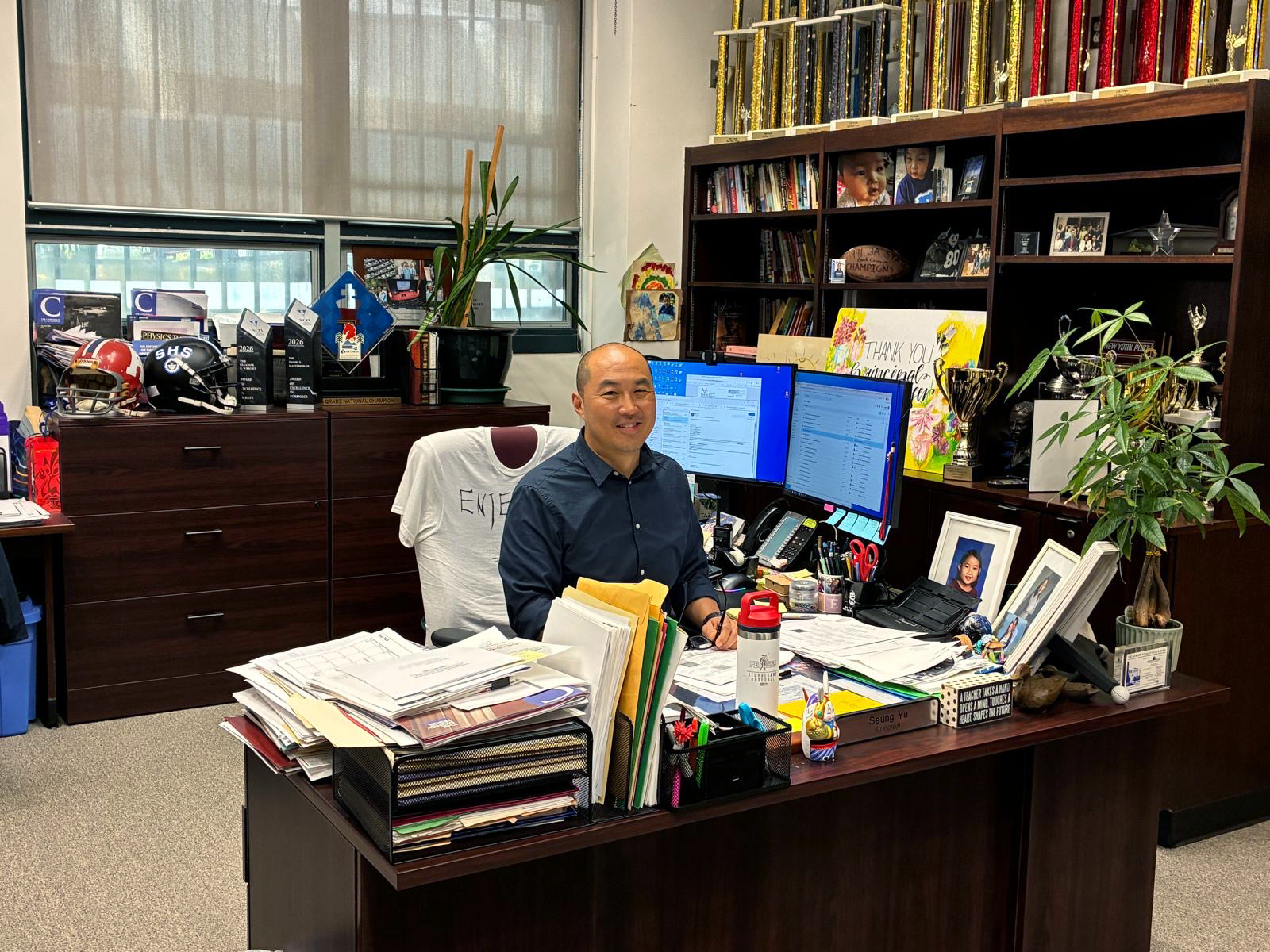
As Stuyvesant begins a new school year, SHSAA Executive Director Diego Segalini ’98 sat down with Principal Dr. Seung C. Yu for the second edition of Principal’s Corner, a recurring conversation about the priorities, challenges, and opportunities shaping the school today.
Now beginning his seventh year as principal, Dr. Yu reflected on a September that feels both familiar and markedly different. For students, he said, much of the excitement remains timeless: reconnecting with friends, returning to clubs and teams, meeting new teachers, and discovering the possibilities of another year at Stuyvesant.
For educators, however, the landscape is changing rapidly.
“I think the adults perhaps feel much different than the young people,” Yu said. Students are excited about “all the different extracurricular activities” and possibilities ahead, while educators are confronting considerable uncertainty about the future of teaching and learning, particularly as technology evolves faster than schools and policymakers can respond.
Navigating Artificial Intelligence
Among the biggest questions facing schools this year is artificial intelligence.
Following last year’s implementation of New York State’s restrictions on internet-enabled devices during the school day, NYC Public Schools is now developing rules governing the use of generative AI. For Yu, the two issues are related, but AI presents a considerably more complicated challenge.
Schools spent the years following the COVID-19 pandemic rapidly expanding digital learning. Now, educators are being asked to reconsider some of that reliance on technology while simultaneously confronting AI tools that are becoming more sophisticated and ubiquitous.
“We went five to six years where, as a result of COVID, we were moving faster to the digital environment,” Yu explained. “And now, starting last year, we’re having to slow it down and kind of revert back.”
At Stuyvesant, that means looking closely at the applications and software teachers use, determining which tools meet NYC Public Schools requirements, and understanding what students and teachers can access through the school network. Privacy is an especially significant concern, particularly when technology could involve personally identifiable student information.
For faculty and staff, Yu stressed that certain responsibilities must remain fundamentally human. Teachers should not outsource grading, feedback on student work, or sensitive responsibilities involving individualized education programs and other student records to AI.
Those responsibilities, he said, should come from “the relationships that the adults have with young people” and from what educators themselves “observe, what they hear, what they see.”
But simply restricting AI inside the building will not resolve the larger challenge. Stuyvesant students will encounter and experiment with these tools outside school, and Yu believes educators and families need to be part of that conversation.
“We’ve got brilliant students, and I think they’re going to experiment, investigate,” he said. His hope is that students will bring questions to trusted adults so that families and educators can learn alongside them and help young people understand both the usefulness and limitations of emerging technology.
For Yu, 2026–27 will therefore be as much a year of learning as rulemaking: understanding what AI can do, where it belongs in education, and, perhaps most importantly, how schools preserve independent thought, intellectual development, and human relationships in an increasingly automated world.
The world Stuyvesant students will enter is changing rapidly. The challenge is not simply preparing them to succeed academically, but helping them develop the judgment, confidence, skills, and experiences to navigate what comes next, and ensuring that every student understands that they belong in the rooms they will someday enter.
Financial Literacy for Life Beyond Stuyvesant
Technology isn’t the only area in which schools are being asked to prepare students for a changing world.
New York State is also expanding personal-finance instruction, but Stuyvesant already has a foundation on which to build.
For several years, Stuyvesant alumnus and teacher David Peng ’06 has taught a dedicated personal-finance course that goes beyond checking accounts and household budgets to explore the psychology and habits surrounding financial decision-making. Stuyvesant will continue offering the course while also incorporating required topics, including budgeting, money management, credit and debt, saving and investing, and risk management, into senior economics classes.
Yu believes financial literacy has become an essential part of preparing students for adulthood.
“We used to assume” that young people would learn these lessons at home, he said. “I think we can’t assume that.”
That is particularly important as students and families confront increasingly consequential financial decisions surrounding higher education. Understanding college costs, borrowing, saving, and long-term financial consequences, Yu said, should begin before students leave high school.
Importantly, financial education at Stuyvesant already extends well beyond the classroom. With funding and support from the Stuyvesant High School Alumni Association, students participate in a growing range of programs that put financial concepts into practice and introduce them to careers in the field.
This year, Stuyvesant’s Fig Capital team won first place overall in the 2026 Wharton Global High School Investment Competition, emerging from a field of nearly 6,000 teams worldwide. Guided by Ms. Maitner and Ms. O’Connell, the students developed an investment strategy and were among just eleven teams invited to present at the finals at the Wharton School of the University of Pennsylvania. The competition challenges students to think about investment strategy, risk, diversification, company and industry analysis, teamwork, and communication.
Stuyvesant students are also gaining exposure to the professional world of finance through Rock the Street, Wall Street, a program designed to introduce young women to financial fundamentals and careers in the industry. Following five sessions at Stuyvesant, nearly 40 students visited the offices of Invesco, where they toured the trading floor and video technology center and spoke with professionals about college, careers, internships, and job-shadowing opportunities. The program is coordinated at Stuyvesant with student leaders and Internship and Student Opportunities Coordinator Harvey Blumm, with support from school faculty and administration.
Together, these SHSAA-supported opportunities illustrate something Yu sees as particularly important: financial literacy is both a practical life skill and a gateway to understanding potential careers.
“We have so many Stuyvesant alums who are well versed in that industry and world,” Yu said, noting the strong student interest in finance at Career Day and the willingness of alumni to speak with students and welcome them into their workplaces. “There’s tremendous interest from the students, and tremendous expertise from our alums.”
Yu sees the State’s new requirements as an opportunity not simply to comply with a mandate, but to build upon this existing foundation. That could eventually include workshops for families, partnerships with financial institutions, and more hands-on opportunities for students to understand everyday financial tools. He even raised the possibility of helping ensure students have practical exposure to basic banking, such as checking and savings accounts.
There is also an increasingly important role for financial education in helping students navigate the sheer volume of information – and misinformation – they encounter online. From investing advice to promises of making money quickly, Yu noted that young people are constantly exposed to financial content through social media.
“We’re going to have to help young people kind of curate accuracies and inaccuracies related to financial topics,” he said.
Making Opportunity the Norm
That conversation led to a broader question: What can alumni do to help prepare today’s students for life beyond Stuyvesant?
For Yu, the answer goes far beyond financial support.
Alumni already return as mentors and speakers, participate in Career Day, open their workplaces to students to visit, provide internships and research opportunities, and introduce young people to professional environments they may never before have encountered.
Yu wants those experiences to become an ordinary part of being a Stuyvesant student.
“For me, it’s always been about making it just the norm of the school that mentorships, career days, opportunities, networking…are just daily things that young people have at Stuyvesant.”
Exposure itself, he believes, is educational.
A student attending a professional networking event for the first time may not know how to introduce themselves or enter a conversation. A student attending the annual Benefit for Stuyvesant may never before have experienced a formal gala. Speaking before hundreds of alumni, visiting a workplace, meeting a professional in a field of interest, or simply learning how to navigate a room can become lessons in confidence and belonging.
“We shouldn’t presume that young people know how to navigate an event like that,” Yu said. Giving them those experiences helps students recognize “that they belong in that world as well.”
His larger goal is to ensure those opportunities reach not only the students who naturally seek them out, but all of Stuyvesant’s approximately 3,300 students.
“There are several students who we need to prompt more, we need to position them,” Yu said. “This will require us to make sure that there’s enough opportunities” to encourage every student to participate.
Stuyvesant's role, Yu said, is to provide an accelerated educational environment for students who thrive in it while continually working to ensure that more young people and families understand that the opportunity exists.
Telling Stuyvesant's Story
Near the end of the conversation, Yu raised another subject he believes deserves greater attention from the Stuyvesant community: how the school is understood beyond its walls.
Public discussion surrounding Stuyvesant and the specialized high schools often focuses heavily on admissions and demographic representation. Yu acknowledged that Stuyvesant does not mirror New York City’s demographics and emphasized the school’s continuing responsibility to foster belonging and inclusion. But he also believes descriptions of the school as simply “not diverse” overlook the complexity of the community students actually experience.
“There is an outside narrative that gets placed on Stuyvesant and other specialized high schools,” he said, that can be very different from “the experience that young people have.”
Stuyvesant’s role, Yu said, is to provide an accelerated educational environment for students who thrive in it while continually working to ensure that more young people and families understand that the opportunity exists.
That includes intentional work supporting communities currently underrepresented at Stuyvesant. Yu pointed to initiatives such as the BIPOC Youth Summit and StuyPrep, SHSAA’s free SHSAT preparation program, as examples of efforts to expand access, strengthen belonging, and help more families see Stuyvesant as a place for them.
And he believes alumni have an important role in telling that fuller story.
Alumni know Stuyvesant not as an abstraction or a headline, but as a place they experienced themselves. They can speak honestly about what the school does well, where it still needs to improve, and what the opportunity meant in their own lives.
“We’re not perfect,” Yu said. “We have a lot of things that we want to support young people and get better in.” But when the public portrayal of Stuyvesant focuses primarily on “what supposedly we’re not doing,” he believes it misses the extraordinary opportunities the school continues to create for thousands of New York City students and families.
As another school year begins, that may be the thread connecting all of these conversations – from artificial intelligence and financial literacy to mentorship, access, and belonging.
The world Stuyvesant students will enter is changing rapidly. The challenge is not simply preparing them to succeed academically, but helping them develop the judgment, confidence, skills, and experiences to navigate what comes next, and ensuring that every student understands that they belong in the rooms they will someday enter.
For Yu, Stuyvesant’s alumni are an indispensable part of making that possible.