
Principal’s Corner: Building Focus, Community, and Opportunity
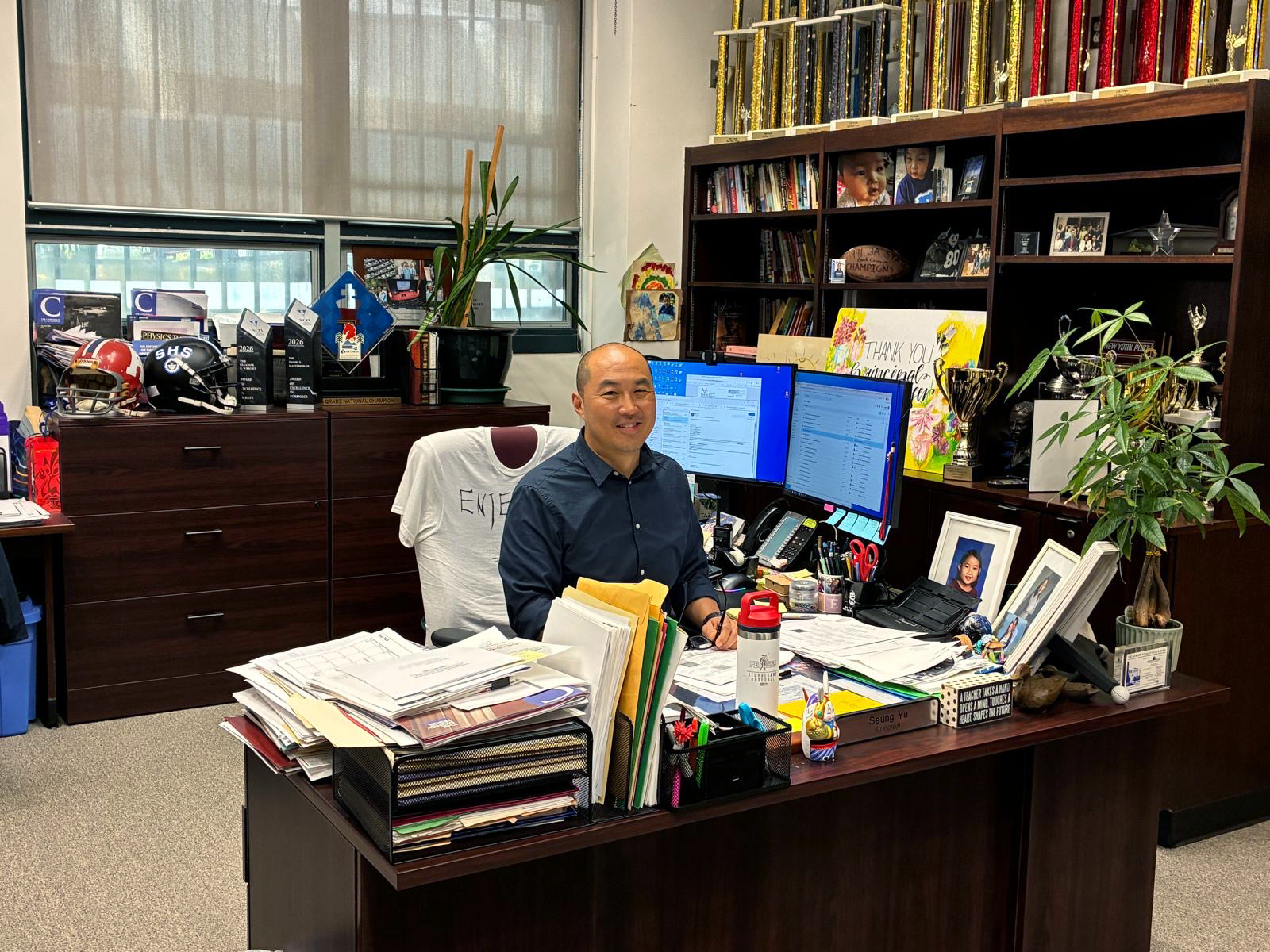
As Stuyvesant prepares to close another successful school year, SHSAA Executive
Director Diego Segalini ’98 sat down with Principal Dr. Seung C. Yu for the inaugural
edition of Principal’s Corner, a new recurring feature designed to give alumni a closer
look at the priorities, challenges, and opportunities shaping the school today.
Their conversation touched on everything from the new statewide cell phone policy to
fostering an inclusive school culture and the exciting future ahead for Stuyvesant
students.
Building Focus in a Digital Age
One of the most visible changes this year has been the implementation of New York State’s new policy restricting the use of web-enabled devices during the school day.
While commonly referred to as a “cell phone ban,” Dr. Yu emphasized that the policy is a statewide mandate that applies to all internet-connected devices (not just smartphones) and is now being implemented in schools across New York.
“We didn’t create this policy at Stuyvesant,” Yu explained. “Our responsibility is to implement it thoughtfully and help students adjust to it.”
The policy reflects growing concerns among educators, parents, and policymakers about the impact of constant connectivity on attention, learning, social development, and mental health. Students are now expected to store their devices during the school day, with limited exceptions during free periods and lunch when they are outside the building.
Although the transition has required adjustment, Yu believes the early results have been encouraging.
“We’ve seen students reading physical books, playing board games, and talking with one another,” he said. “Those social interactions that were missing during COVID, and even before COVID, are beginning to reappear.”
Teachers have also reported fewer classroom distractions and greater student engagement. At the same time, Stuyvesant continues to navigate the reality that students increasingly rely on technology for learning, homework submission, collaboration, and research.
“We’re living in a moment where schools are simultaneously reducing dependence on personal devices while trying to prepare students for a world increasingly shaped by technology and artificial intelligence,” Yu said. “The challenge is helping students learn to use these tools intentionally rather than allowing the tools to control their attention.”
As both an educator and a parent, Yu views the policy as an opportunity to help students develop healthier habits around technology.
“I do think these devices have become significant attention grabbers,” he said. “There will be growing pains, but ultimately I think this will be beneficial for students.”
To support the transition, the school has added book-sharing stations throughout the building and encouraged students to reconnect through conversation, games, and other in-person activities during free periods. For Yu, the goal is not simply limiting screen time, but helping students rediscover the value of focus, presence, and human connection.
Creating a Community Where Everyone Belongs
A number of alumni have reached out over the past two years expressing concern about the rise of antisemitism nationally and asking how the school is responding. I appreciated the opportunity to attend the Educational Leadership Conference on Antisemitism & Jewish Inclusion alongside Dr. Yu, members of his senior leadership team, representatives of the Parents’ Association, and fellow educators from across the region, and I asked him to share some reflections from that experience.
Earlier this year, Dr. Yu joined representatives from the Alumni Association, Parents’ Association, and members of his senior leadership team at the Educational Leadership Conference on Antisemitism & Jewish Inclusion, a gathering focused on understanding and addressing the rise of antisemitism in educational settings.
The timing was significant. In recent years, rising incidents of antisemitism nationally have prompted concern among many Jewish students, families, and alumni. Some members of the Stuyvesant community have expressed a desire to see stronger conversations and more visible efforts around addressing antisemitism and ensuring Jewish students feel fully supported.
For Yu, attending the conference was an important opportunity to listen, learn, and deepen the school’s commitment to creating an environment where every student feels welcome.
“I think it’s really important that every student and family can call Stuyvesant home,” he said. “That includes making sure that when members of our community are experiencing fear, concern, or discrimination, we take the time to listen, learn, and respond.”
Rather than approaching the conference as a one-day solution, Yu viewed it as part of a broader effort to strengthen understanding and foster dialogue across the school community.
“We weren’t there because one group had all the answers,” he said. “We were all learners. We listened to one another, shared our experiences, and took steps toward greater understanding.”
The conference explored both historical and contemporary manifestations of antisemitism while highlighting practical strategies for building more inclusive school communities. For Yu, the experience reinforced the importance of ensuring that Jewish students – and more broadly the student body – feel seen, supported, and valued.
“Stuyvesant is one of the few places where students from every borough, faith tradition, ethnicity, and socioeconomic background come together in one building,” he said. “That diversity is one of our greatest strengths, but it also requires us to be intentional about building understanding and respect.”
Throughout the year, Stuyvesant continues to host a wide range of multicultural celebrations, heritage events, affinity group activities, and student-led initiatives that encourage students to learn from one another and build meaningful connections across differences.
The conference is expected to inform future conversations and professional development efforts within the school community. For Yu, the goal is not simply responding to incidents when they occur, but continuing to build a culture where students of every background can thrive.
Stuyvesant should always be a place you can call home, he said. And what makes this community extraordinary is that so many alumni continue to come back and help the next generation succeed.
Looking Toward the Future
As he approaches the end of his sixth year as principal, Dr. Yu remains optimistic about Stuyvesant’s future.
Among the developments he is most proud of are the growing partnerships between the school, the Alumni Association, the Parents’ Association, and countless volunteers who help create opportunities for students.
Over the past several years, those partnerships have expanded access to national competitions, career exploration programs, alumni panels, mentorship opportunities, research experiences, and enrichment programs across a wide range of fields.
“I would love to see every student have a mentor,” Yu said. “The more we can surround students with caring adults who can share their experiences, provide guidance, and help them navigate an increasingly complex world, the better.”
Yu is equally excited about the continued evolution of the school’s learning spaces. Recent additions include the Lin Brothers Robotics Lab, Environmental Science Lab, Media Lab, and Math Center in development. Looking ahead, he sees opportunities to further enhance facilities while creating new partnerships that extend learning beyond the walls of 345 Chambers Street.
“We need our physical spaces to match the extraordinary talents of our students,” he said.
Perhaps most importantly, however, Yu hopes to continue cultivating a culture rooted in kindness, respect, and collaboration.
He recalled an email he received from a student shortly after the return from the pandemic.
“She wrote to me and said, ‘I think Stuyvesant has gotten a little bit kinder.'”
The comment has stayed with him ever since.
“I’ve always believed that improving a school isn’t about making dramatic changes overnight,” Yu said. “It’s about getting one percent better every day.”
A Message to Alumni
As the conversation concluded, Yu expressed gratitude for the support and engagement of the alumni community.
“Anyone who graduates from Stuyvesant understands how special this institution is,” he said. “What has always impressed me about our alumni is how much they care.”
He encouraged alumni to continue sharing their time, expertise, and passion with future generations of Peglegs.
“Stuyvesant should always be a place you can call home,” he said. “And what makes this community extraordinary is that so many alumni continue to come back and help the next generation succeed.”
For Yu, that spirit of paying it forward remains one of Stuyvesant’s greatest strengths—and one of its brightest hopes for the future.