
Sam Rosen ’64: The Voice of the Rangers – 2026 Outstanding Pegleg in Broadcasting Award
For more than four decades, millions of hockey fans have heard the unmistakable voice of Sam Rosen ’64, the longtime play-by-play announcer for the New York Rangers on Madison Square Garden Network. His enthusiastic calls and deep knowledge of the game have made him one of the most recognizable broadcasters in sports. But long before Madison Square Garden, ESPN, and Stanley Cup broadcasts, Rosen was a Stuyvesant student commuting into Manhattan and discovering his passion for sports.
For Rosen (born Rosenblum), the path to Stuyvesant began with family. “My parents were from Poland,” he recalled. “They survived World War II by escaping before the Nazis invaded and later came to America in 1949. Education was always the foundation of our family. Like many Eastern European Jewish families, my parents believed education was everything.”
It was Rosen’s older brother who first suggested Stuyvesant. At the time, the city’s specialized high schools—Brooklyn Tech, Stuyvesant, and Bronx Science—were known as places where academic ambition and opportunity intersected. “After discussions, Stuyvesant seemed to be the best fit,” Rosen said. “When I took the test, I was accepted—and that started my journey.”
Rosen attended Stuyvesant when the school was still located on East 15th Street, a much smaller campus than today’s building overlooking the Hudson River. “It was a different time,” he said. “The school was just a building on 15th Street off First Avenue. It wasn’t an overly impressive facility.” What it lacked in amenities, however, it made up for in opportunity—and challenge.

Rosen was an avid athlete growing up, and sports remained a central part of his life at Stuyvesant. “I was a big sports person,” he said. “We grew up playing in schoolyards, parks, and the streets. I gravitated toward athletics.”
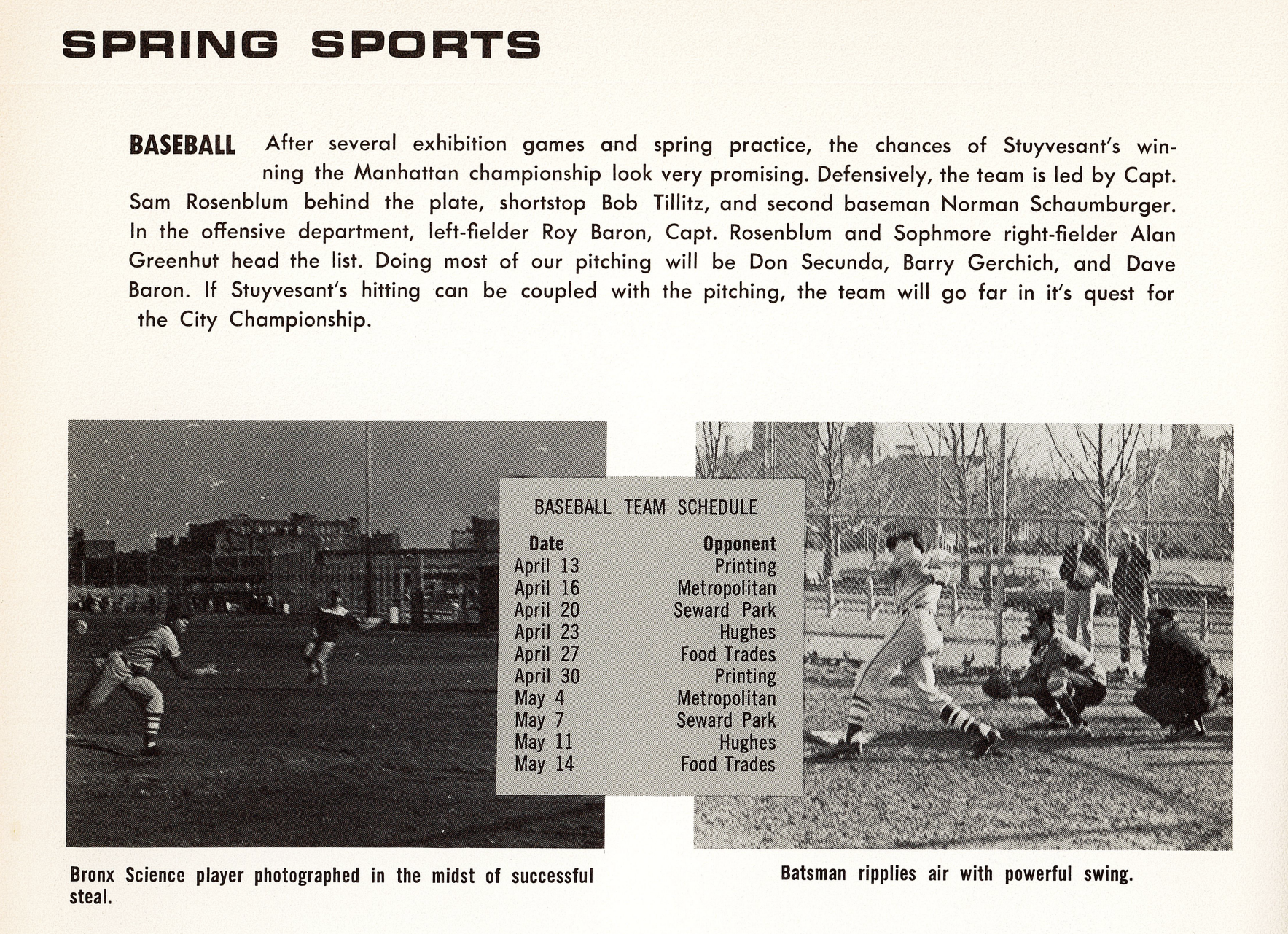
Facilities were limited. The gymnasium had pillars that made basketball difficult, and baseball practice often took place far from campus. “There was no baseball field nearby,” Rosen recalled. “We practiced down near the East River and played games in Central Park on 96th Street. It was an effort—but I loved it.”
[Stuyvesant] is something special. You may not realize it when you’re there—but later in life, you understand how much it meant. — Sam Rosen '64
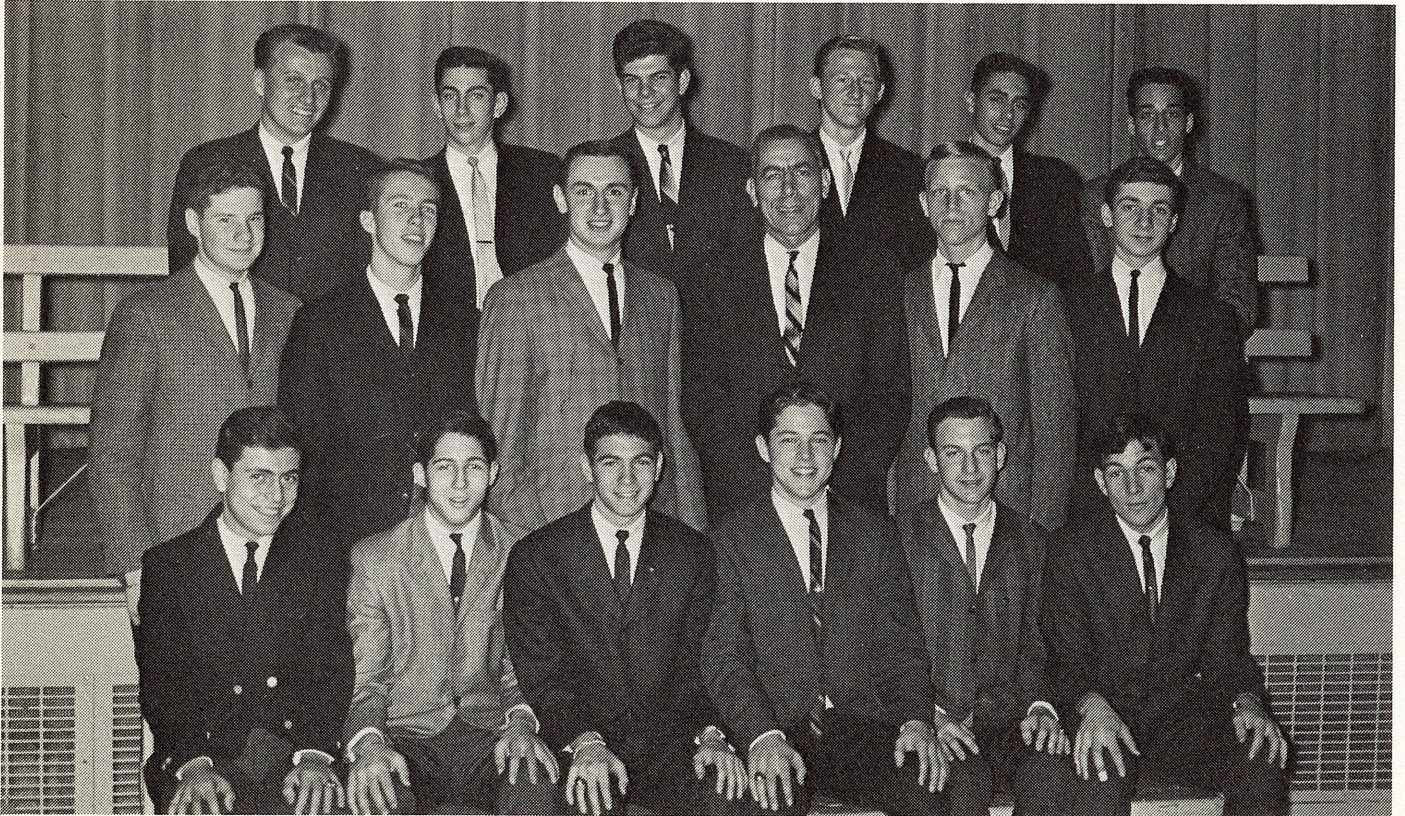
He captained the Stuyvesant baseball team in 1964, a leadership experience that would foreshadow the teamwork that would define his professional career. Among the teachers and mentors who left lasting impressions were mathematics teacher Irving Weltman and baseball coach Sebastian Cavallaro.
“Coach Cavallaro wasn’t overly knowledgeable in baseball,” Rosen said with a smile. “But he was very good with the players. He let us run the team and focused on teamwork and keeping everyone together.”
While sports dominated Rosen’s extracurricular life, another interest was quietly taking hold. “I always had a transistor radio with me,” he said. “I listened to basketball, baseball, football—anything I could. That’s where my interest in broadcasting began.”
Stuyvesant opens doors. Because of the education you receive, you gain the confidence and understanding to contribute—not just professionally, but to your community. — Sam Rosen '64
After graduating from Stuyvesant, Rosen attended City College of New York, where he continued playing baseball and eventually captained both the freshman and varsity teams. But during college, he began to realize that his future might not be on the field.
A pivotal moment came when Rosen landed a part-time job at the all-news radio station WINS in 1966. “I worked in the newsroom,” he said. “Sorting copy, helping the newscasters, assisting with the sports segments. I learned what engineers did, what reporters did, how broadcasts came together.” That experience revealed an important truth about broadcasting. “It’s never just the person with the microphone,” Rosen explained. “It’s a whole team effort. Learning that early helped me appreciate everyone involved in putting a broadcast together.”
Another key experience came from a television broadcasting course at Brooklyn College, where students rotated through every role in a studio production. “One week you were the camera person, the next week the director, the next week the talent,” Rosen said. “That’s where I really learned how television worked.” These early experiences laid the groundwork for a career that would unfold step by step.
Like many broadcasting careers, Rosen’s began through persistence, preparation, and a bit of luck. While working at WINS, Rosen met Jim Gordon, the station’s morning anchor who also called Knicks games on television. “Jim Gordon became my mentor,” Rosen said. Through Gordon’s encouragement and connections, Rosen eventually found opportunities that led him deeper into sports broadcasting.
In the late 1960s and early 1970s he worked at radio stations in Connecticut before joining United Press International (UPI), where he covered virtually every sport imaginable. “I covered horse racing, golf, table tennis—whatever came along,” he said. “I also covered the World Series from 1975 through 1979.” Then, in 1979, another opportunity arrived: ESPN.
“Scotty Connell called me and asked if I wanted to do some play-by-play,” Rosen said. “I wound up doing numerous sports—football, baseball, basketball, hockey, even Australian rules football.”
But the moment that would define his career came earlier, through another unexpected opening. Jim Gordon had been scheduled to fill in for legendary broadcaster Marv Albert during a Knicks radio broadcast—but Gordon became ill and recommended Rosen as his replacement. “That was my entry into Madison Square Garden,” Rosen said. The opportunity turned into a long relationship with the network.

“I signed my first full-time contract with Madison Square Garden in 1982,” he said. “And in 1984 they asked me to succeed Jim Gordon as the play-by-play announcer for the Rangers.” More than forty years later, Rosen remains synonymous with the team.
Rosen’s career expanded well beyond Rangers hockey. For two decades he called NFL games for Fox Sports, and he also worked postseason hockey broadcasts for Westwood One radio. “I kept a tremendous pace,” he said. “Travel, broadcasts, multiple networks—it was an exciting field.”
Today, as he gradually transitions toward retirement, Rosen is slowing down—but not stopping.
“If I could just do the games themselves, I’d still be doing it,” he said with a laugh. “It’s all the travel and time away that becomes difficult.” Instead, he is exploring ways to share his experience with the next generation. “If I can help young broadcasters or people interested in media, that would be very meaningful to me,” Rosen said. “When people come up and say they were inspired by my work, that tells me it meant something.”
Looking back, Rosen credits Stuyvesant with providing a foundation that shaped his entire life. “When I arrived at Stuyvesant, it was eye-opening,” he said. “I was surrounded by people who were as smart or smarter than I was. It pushed me to work harder.” That academic environment—and the school’s location in the heart of New York City—expanded his worldview. “You were exposed to everything happening in the city—politics, community issues, civic life,” he said. “It gave you a greater understanding of the world around you.”
That perspective stayed with him throughout his career. “Stuyvesant opens doors,” Rosen said. “Because of the education you receive, you gain the confidence and understanding to contribute—not just professionally, but to your community.”
For today’s Stuyvesant students, Rosen offers a simple message. “Stay involved,” he said. “There’s strength in numbers, and there’s strength in community. Support each other and give back whenever you can.” It is advice drawn from decades of experience—and from a school that continues to shape generations of students.
“Stuyvesant has been a leader in education for a very long time,” Rosen said. “It’s something special. You may not realize it when you’re there—but later in life, you understand how much it meant.”